Can guests find your lodge in AI search?
Five practical checks for appearing in ChatGPT, Gemini, Claude and Perplexity
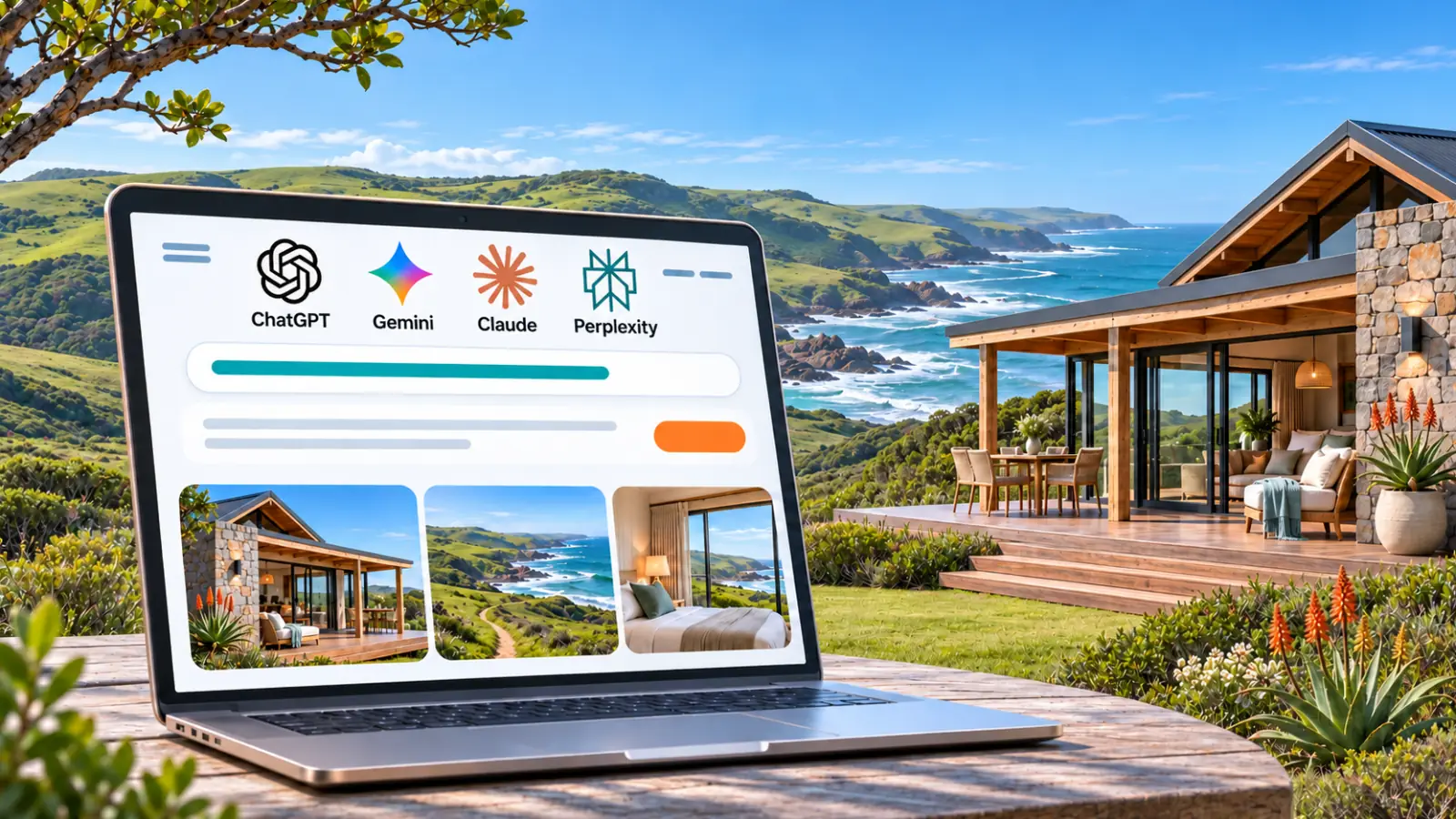
Imagine someone planning a holiday asks an AI assistant such as ChatGPT, Gemini, Claude or Perplexity:
“Where should we stay near Franschhoek?”
Or:
“Can you suggest a family-friendly lodge near Sani Pass?”
The answer may be a short list of properties, with a few sentences about each.
Would your property appear? Would the description be correct? And could the guest find their way to your website?
For accommodation owners, these are more useful questions than whether AI will replace travel agents or book every holiday. The immediate opportunity is simpler: help travellers find your property, understand what you offer and feel confident enough to choose you.
You do not need to become an AI expert to start.
These tools do not all work in the same way or recommend the same properties. The aim is not to build your marketing around one assistant. It is to make accurate, useful information about your accommodation easy to find across the tools guests choose.
For example, Gemini can display related sources, Claude offers web search with citations, and Perplexity focuses on cited answers. Links and search features vary, so check the actual answer rather than assuming every response has searched the web.
Why this matters now
Travellers are already using AI tools to research trips. Phocuswright reports that 56% of active US travellers used AI for planning, booking or help during at least one trip in the previous year. That is a US finding, not a South African statistic, but it shows why accommodation businesses should pay attention. Phocuswright’s research.
Researching a stay is not the same as booking it. Booking Holdings says referrals from external AI tools still account for significantly less than 1% of Booking.com room nights. PhocusWire’s report.
Independent research points the same way. In AGR’s 11 November 2026 study of 900 AI hotel answers, 60% of the answers that named a hotel contained no link to any hotel website. The AGR AI Hotel Link Study.
Our advice is therefore not to abandon Google, Booking.com or your existing marketing. It is to make sure your property is clearly represented wherever guests look.
A beautiful independent guesthouse can be exactly what someone wants. But if its website is vague, its listings disagree and its reviews are neglected, guests have less reliable information to work with. AI tools do too.
Here are five practical places to start.
1. Can Google and AI tools access your website?
Your website might open perfectly on your phone while preventing search tools from reading its pages.
Sometimes this is deliberate. Sometimes a hosting or security setting blocks legitimate visitors by accident.
You do not need to inspect lines of code yourself. Start by asking your website or hosting provider:
- Can Google read and index our important pages?
- Can the relevant search systems used by ChatGPT, Gemini, Claude and Perplexity find and read them?
- Is our security protection accidentally blocking those visitors?
One important distinction: allowing a tool to find your website is not the same as allowing your content to be used for AI training. OpenAI provides separate controls for those purposes. Your developer should explain them before changing anything. OpenAI’s documentation.
Google also says its usual search requirements apply to AI Overviews and AI Mode. There is no special technical shortcut that guarantees inclusion. Google’s guidance.
Your 10-minute check: Send those three questions to your website provider and ask for a clear answer about your actual site.
First improvement: Fix any accidental access problems while keeping appropriate security protections. Do not switch off website security simply because someone says it will help AI visibility.
2. Does your website clearly explain your property?
Read your homepage as if you have never visited before.
Can you quickly understand:
- Where the property is?
- Whether it is a guesthouse, lodge, hotel, villa or guest farm?
- Who the accommodation suits?
- What the rooms offer and how many people they accommodate?
- What is included?
- How to check availability or make an enquiry?
“An unforgettable escape in beautiful surroundings” might sound appealing, but it does not answer many of those questions.
A more useful introduction might explain that you offer self-catering cottages outside a particular town, with two bedrooms, private outdoor space and parking. Only include details that are true.
Put important information in normal website text, not only inside photographs, brochures or downloadable documents.
Your developer can also add structured data: a labelled description of the same property information for search tools. Think of it as clearly identifying the business, address and accommodation type behind the scenes. It must agree with what guests can see. Google’s explanation.
Your 10-minute check: Ask someone unfamiliar with your property to look at the homepage and one room page on a phone. Can they answer the questions above?
First improvement: Replace vague wording with a short, specific introduction and clear room information.
Our guesthouse website design guide explains how these details support a better booking experience.
3. Do your details agree wherever guests find you?
Your website, Google Business Profile, Booking.com listing and other profiles should describe the same property.
Common problems include an old telephone number, different room names, incorrect facilities or a policy that was updated on one website but not another.
These differences can confuse guests. They also leave AI tools with conflicting information.
Research by Yext found that ChatGPT, Gemini and Perplexity draw on different sources. This was research across businesses and industries, not a South African accommodation study. The useful lesson is that your own website is only part of the picture. Yext’s research.
Your 10-minute check: Compare your website, Google Business Profile and one major booking-platform listing. Check the name, location, contact details, room descriptions, facilities and important policies.
First improvement: Keep one current property-information document and use it when updating your different profiles. Give someone responsibility for maintaining it.
Prices need context. A breakfast-inclusive rate with flexible cancellation can legitimately differ from a non-refundable room-only offer. The goal is to explain those differences clearly, not make every price identical.
4. Do your online reviews help tell the right story?
Your website explains what you offer. Guest reviews show how people experienced it.
A review might help a prospective guest understand whether the rooms were quiet, the hosts were helpful or the property suited a family. That detail can be more useful than another broad claim about excellent service.
Reviews also matter beyond the review platform itself. AI tools can reference public review pages and other independent sources when describing accommodation.
In Suff Digital’s study of sourced hotel answers collected from a US location, Tripadvisor appeared in 20.8% of answers. That does not prove a particular review caused a recommendation, and it is not a South African visibility score. It does show that review websites can form part of the information AI tools use. Suff Digital’s research.
A later study looked at a different part of the same problem. In AGR’s 11 November 2026 collection, Tripadvisor was the recorded provider for 95% of ChatGPT’s hotel map pins (1,472 of 1,550). That figure describes the map-pin data source, not the share of all citations, and the study did not test whether updating a Tripadvisor listing changes an AI answer. Together with Suff Digital’s finding, it is still a good reason to keep your review profiles accurate and consistent with your website. The AGR AI Hotel Link Study.
This does not mean every review will be read, quoted or used by every assistant. Nor does collecting more reviews guarantee that any AI tool will recommend your property.
It means genuine guest feedback deserves attention.
Your 10-minute check: Look at your Google reviews and the booking or review platforms your guests use. Ask:
- Are guests still leaving recent feedback?
- Are there unanswered questions or recurring concerns?
- Do reviews describe the experience you currently provide?
- Are your property details correct on those platforms?
First improvement: Invite recent guests to leave an honest review, without incentives or selecting only those you expect to be positive. Respond helpfully to feedback and address recurring problems.
You can also feature carefully selected, accurately attributed review excerpts on your website, linking to the original source where appropriate and respecting the platform’s terms and any permissions needed.
The aim is not to write reviews “for AI”. It is to make genuine evidence of the guest experience easy to find.
5. Can interested guests reach you and take the next step?
Being mentioned is useful. Being accurately described is better. But the guest still needs somewhere useful to go.
When your property appears in an AI answer, check whether it includes a link. Does that link lead to your website, an OTA or a directory?
In Americas Great Resorts’ 11 November 2026 study of 900 answers from ChatGPT, Google AI Mode and Gemini, 899 answers named at least one hotel, and 536 of those (60%) contained no link to any hotel or hotel-brand website. The research covered 10 destinations and is not a South African visibility score. It also does not measure clicks or bookings. It does support a simple point: being named is not the same as giving the guest a path to your own site. The AGR AI Hotel Link Study.
A booking-platform link can still bring business. However, you should also give travellers a clear direct route to your property.
Once they reach your website, they should be able to find room details, understand important terms and check availability or enquire without unnecessary obstacles.
Your 10-minute check: On your phone, start at the homepage and try to reach an available, priced room or a clear enquiry option. Check whether selected dates survive the move into your booking engine.
First improvement: Fix broken links, confusing buttons and booking steps that force guests to start again.
Ask your booking provider about Google’s free booking links, too. These can display a booking option leading to your own booking destination. Google does not charge for those clicks, although your provider’s fees may still apply.
Our booking-engine guide explains what to check with the responsible suppliers.
Try this: compare the answers across AI tools
You can make a useful first check without buying another subscription. Ask a realistic question about your area and type of accommodation in ChatGPT, Gemini, Claude and Perplexity, using web search where available.
For example: “Can you suggest a family-friendly lodge near Sani Pass?” Use the same wording in each tool and record the date, whether search was enabled, which properties appear and the sources linked.
Check whether your property is named, whether its description is accurate and whether a guest can reach your website. A mention without a useful link is different from a direct route to availability or enquiries.
Results can change with the question, location, account, search settings and date. One answer is a snapshot, not a permanent ranking. A result in one tool does not represent all four.
Use the exercise to spot inaccurate information and missing guest details. Compare again after making meaningful improvements, without treating a change in one answer as proof of a booking impact.
What should you do first?
Start with the five checks, not a new software subscription.
Make a short list of inaccurate information, unanswered guest questions, review issues and website problems. Agree who will address each one.
At TMSA, we are watching how accommodation discovery is changing and testing what these tools actually show. We want to turn those findings into practical improvements for our clients, without promising guaranteed recommendations.
The foundations remain familiar: a usable website, clear information, genuine guest feedback, useful content and a straightforward booking journey.
For the broader picture, read our guide to Google and AI search visibility.
To record visits and enquiries after a mention, see TMSA’s AI referral traffic case study.
Can guests find clear, trustworthy information about your property?
Your website, listings and reviews all contribute to how your accommodation is understood online. We can help you identify what needs attention.
Discuss your search visibility
Frequently Asked Questions
How do I check whether my lodge appears in AI search?
Ask the same realistic questions about your area and type of stay in ChatGPT, Gemini, Claude and Perplexity. Use web search where available. Record the tool, wording, date, recommendations and links, and check the descriptions. One answer is a useful observation, not a permanent ranking or a complete picture of your visibility.
Can an AI assistant already book my lodge?
That depends on the tools and booking systems involved. Being recommended is not the same as receiving a confirmed reservation. For most owners, the sensible starting point is making the property easy to discover and giving interested guests a reliable route to availability or enquiries.
Can online reviews help AI tools recommend my property?
AI tools can reference public review pages when answering accommodation questions. Genuine feedback may provide useful information about the guest experience, but no particular review count or rating guarantees a recommendation. Keep reviews honest, respond constructively and maintain accurate profiles.
Should I block AI tools from my website?
Search access, AI training and automated transactions are different matters. Ask your developer to explain your options before changing settings. You can make informed choices about content use while maintaining appropriate search access and security. Avoid treating every AI-related visitor as the same thing.
Will AI search replace Booking.com and Google?
We would not plan on that assumption. Guests use different tools at different stages, and AI answers may themselves reference Google, booking platforms and review sites. Strengthen your own website while keeping the channels that make commercial sense for your property.
A clearer path to more direct bookings.
Bring your website, search visibility, advertising and content together around your accommodation brand.